
How to taste extra virgin olive oil at home (without being a sommelier)
Blue glass, palm of your hand and three steps. The same ritual used in professional sensory panels, adapted to your kitchen.
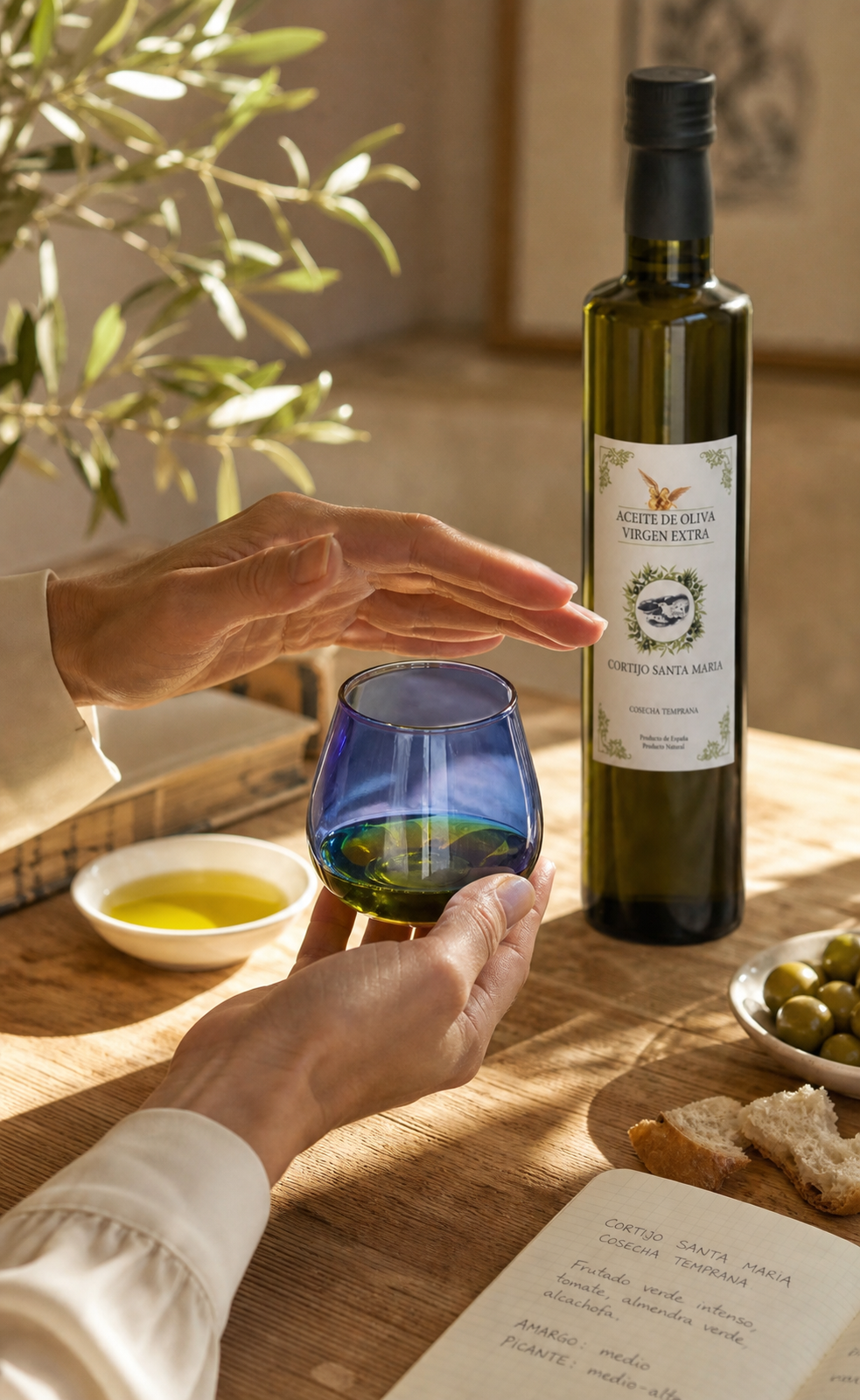
Tasting an EVOO doesn't require expensive gear or technical vocabulary. It requires silence, a spoonful of oil and three minutes. Official sensory panels use cobalt-blue glasses covered with a watch-glass to hide the colour, but at home a small shot glass and the palm of your hand will do.
Step one is visual, and then you'll disable it. Hold the oil against the light. A good early harvest will be deep green with gold highlights and slightly dense when you swirl the glass. Once you've looked, cover the glass: colour can be misleading.
Step two is olfactory. Warm the glass between your palms for about thirty seconds. That's enough for volatile aromas to release. Uncover it and bring your nose close: look for grassy notes — cut grass, tomato leaf, fig leaf — and a discrete green apple in the background. If you find musty, vinegar, fermented-olive or «rancid-cardboard» smells, that's a flaw: the oil is off.
Step three is palate. Take a teaspoon, hold it at the front of your tongue, breathe in a little air through your mouth —like a quiet slurp— and let the oil coat your whole mouth. Look for three things: fruitiness (the intensity of the olive), bitterness (in the middle of the tongue) and pepperiness (in the back of the throat, a few seconds in). When all three appear balanced, you are tasting a characterful EVOO.
Train your palate at home with small comparisons: taste an early-harvest EVOO next to a refined supermarket oil. The difference, even for an untrained palate, is overwhelming. That exercise is also what lets you — over time — justify every euro you pay for an artisan oil.